Sharik’s humanized state
The Heart of a DogSharik’s humanized state is the outcome of Professor Preobrazhensky’s experiment on a dog: a new human form emerges, but not a settled human identity. The transformation begins as an investigation into transplantation and rejuvenation, becomes a subject of observation and public rumour, and soon raises questions of naming, kinship, registration, and responsibility. Its central contradiction is that bodily and linguistic change can be documented, while social recognition remains contested.
Experimental Origins and Diagnosis
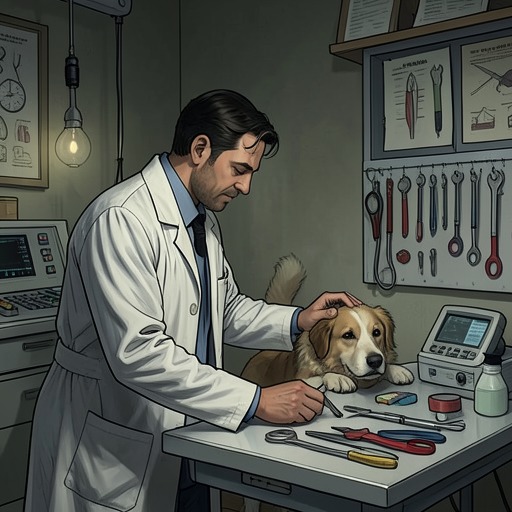
On December 23, at 8:05 p.m., Professor Preobrazhensky began an operation intended to study the combined transplantation of a pituitary and testes and their effects on an organism, including the prospect of cellular rejuvenation. The subject was Sharik, a male mongrel dog estimated to be about two years old. The professor replaced the dog’s testes with human testes and then, after opening the cranial roof, replaced the pituitary with a human one. Doctor Bormenthal assisted. The operation thus made the humanized state a deliberately produced hybrid condition, not an unexplained appearance or a natural developmental change.
The researchers initially interpreted the consequences amid uncertainty. On January 8, they reached a diagnosis: pituitary transplantation had caused total humanisation rather than rejuvenation. The correction did not diminish the experiment’s scientific importance in the professor’s assessment. It did, however, revise its purpose in retrospect. What had been framed as an inquiry into rejuvenation had produced a human being, making the identity of the transformed subject—not merely the viability of the graft—the central problem.
Physical and Linguistic Transformation
The change becomes visible in stages. Sharik first walks through the flat as a short, loosely built human male, laughing at the electric light and registering the word “Bourgeois.” His early speech includes swearing that Doctor Bormenthal describes as mechanical and seemingly disconnected from its surroundings. That distinction later changes: on January 11, the creature responds to an instruction not to throw food scraps on the floor with a relevant retort. Bormenthal takes the response as evidence that the words are no longer merely disconnected sounds and that Sharik understands what is said to him.
By January 12, Sharik can sustain a conversation. Bormenthal proposes that the implanted pituitary has activated the speech centre in the canine brain, releasing language that had accumulated during the dog’s earlier life. He further suggests that Sharik had absorbed street language as a dog and that his ability to read may have been present from the beginning. These are the doctor’s hypotheses, not a final account of how the transformation works. In his notes, he presents the pituitary’s role in human appearance and the sudden emergence of speech as findings that open a new field of investigation.
Bormenthal’s January 17 summary records the resulting state in practical terms: Sharik is physically a complete human being, eats human food, dresses himself, and can converse normally. The concise inventory captures how far the transformation has proceeded, but it does not establish that every aspect of human identity follows automatically from bodily change. The narrative’s later disputes show that the new organism’s status remains a matter of argument and institutional handling.
Naming, Kinship, and Recognition
The transition from dog to human is also marked by names. The professor first calls the dog Sharik while offering him food, and the name accompanies the initial bond between the animal and the man who intervenes in his life. Later, when a name is needed for registration, the transformed man proposes “Tолigraph Poligraphovich” as a given name, then identifies his surname as his real name. Shvonder offers to prepare a certificate identifying him as Poligraph Poligraphovich Sharikov, born in the flat. The professor objects that this account is absurd because Sharikov was not born there in an ordinary human sense. Naming gives the transformed subject an administrative form, while the proposed certificate exposes how poorly that form fits his actual origin.
The same unsettled status appears in the dispute over family language. When Sharikov calls the professor “Dad,” the professor rejects the familiarity and insists that he be addressed by name and patronymic. Sharikov argues that he did not request the operation and invokes the possibility that he and his relatives would not have consented. His claim does not undo the transformation, but it turns the experiment’s origin into an argument about responsibility: the creator cannot simply treat the resulting person as a dependent animal, while the transformed subject uses the language of family and consent to resist being managed as one.
Registration is another contested measure of personhood. Sharikov wants to be placed on the register and given an identity card, saying that he does not want to be arrested as a deserter. The professor calls him an unnatural phenomenon or artefact and cannot readily say where he should be registered. The exchange makes the gap between the physical result and civic recognition explicit: a human appearance and conversational ability do not, on their own, settle what documents the state can issue or what category can contain him.
Conflict and Public Consequences
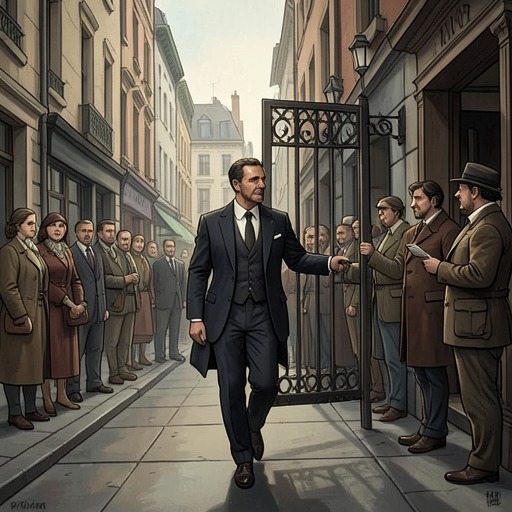
The transformation does not remain a private experiment. Rumours spread through Moscow, crowds gather outside the professor’s home, and reports in the papers distort events, including a claim about a child born able to play the violin. The professor’s consultations become impossible; he receives eighty-two telephone calls in a day, and the telephone is cut off. Shvonder and the house committee also appear, although they cannot explain why they have come. Public attention turns a scientific result into a spectacle, while administrative and popular stories supply explanations that the experiment itself does not support.
At home, the practical consequences of Sharikov’s new human life become a continuing source of conflict. The professor reprimands him for disorderly conduct and for troubling Zina; Sharikov answers that he is being subjected to rules as though he were on a tram and objects that the professor performed the operation without his permission. Later, he announces that he and the typist are getting married and that she will come to live with him, adding that Bormenthal will have to leave the waiting-room. The announcement shows Sharikov asserting a household future of his own, while the professor’s courteous invitation to speak with the young woman privately signals the seriousness with which he receives her presence and the claim being made on the flat.
The final official account makes the transformation’s consequences sharper rather than resolving them. A man reads an accusation charging the professor, Bormenthal, Zinaida Bunina, and Darya Ivanova with murdering Poligraph Poligraphovich Sharikov, identified as a sub-department controller of the Moscow Cleansing Department. The professor responds by asking who Sharikov is and then describing him as his dog, the one he operated on. The contrast between the charge’s formal human identity and the professor’s evasive description leaves the question of recognition deliberately unsettled: the state’s paper names Sharikov as an official, while the professor invokes the animal origin that produced him.
Significance of the Humanized State
Sharik’s humanized state makes the boundary between animal and human a material, observable transformation while refusing to make that boundary a simple threshold of belonging. The human grafts produce a person who walks, speaks, dresses, eats, and makes claims about registration and household life. Yet the same person remains framed by the language of experiment, artefact, dog, and official identity, each term carrying different consequences for how others treat him.
The records intensify this tension. Bormenthal’s dated notes give the change a scientific chronology, from the stated experimental purpose to the diagnosis of total humanisation and the final catalogue of capacities. But the archive cannot itself settle the social questions the transformation creates. A name can be proposed, a certificate drafted, and an accusation read aloud; none makes the competing accounts of origin and personhood disappear. The state’s significance lies in this unresolved interval between becoming human in bodily and linguistic terms and being recognized, addressed, and held responsible as a human being.